The institutional privacy landscape in 2026: How the credible options actually differ

Eighteen months ago, an institution asking "which blockchain privacy solution should we evaluate?" faced a market full of marketing and short on production. That conversation has changed. The market has matured. Multiple credible options exist, several with live deployments, real institutional partners, and academic or engineering credentials that can be checked rather than taken on trust.
This is good for the industry. It is also a new problem for procurement teams. The question is no longer "is this real?" The question is "which of these credible options actually matches the problem we are trying to solve?"
This post is a fair walk through the most discussed options in the institutional privacy space as of mid-2026: Zama, Railgun, Prividium, Tempo Zones, and Aztec Network, with brief notes on Aleo, COTI, and Midnight. The intent is to describe each one accurately, identify the specific problem it was designed to solve, and surface the dimensions on which an institutional buyer should be evaluating any of them, including Enygma.
We have a position. We are not pretending we do not. But the position is more credible when the comparison is honest, and the comparison is more useful when it treats each option as a serious answer to a specific question rather than as a competitor to be diminished.
The dimensions that distinguish solutions
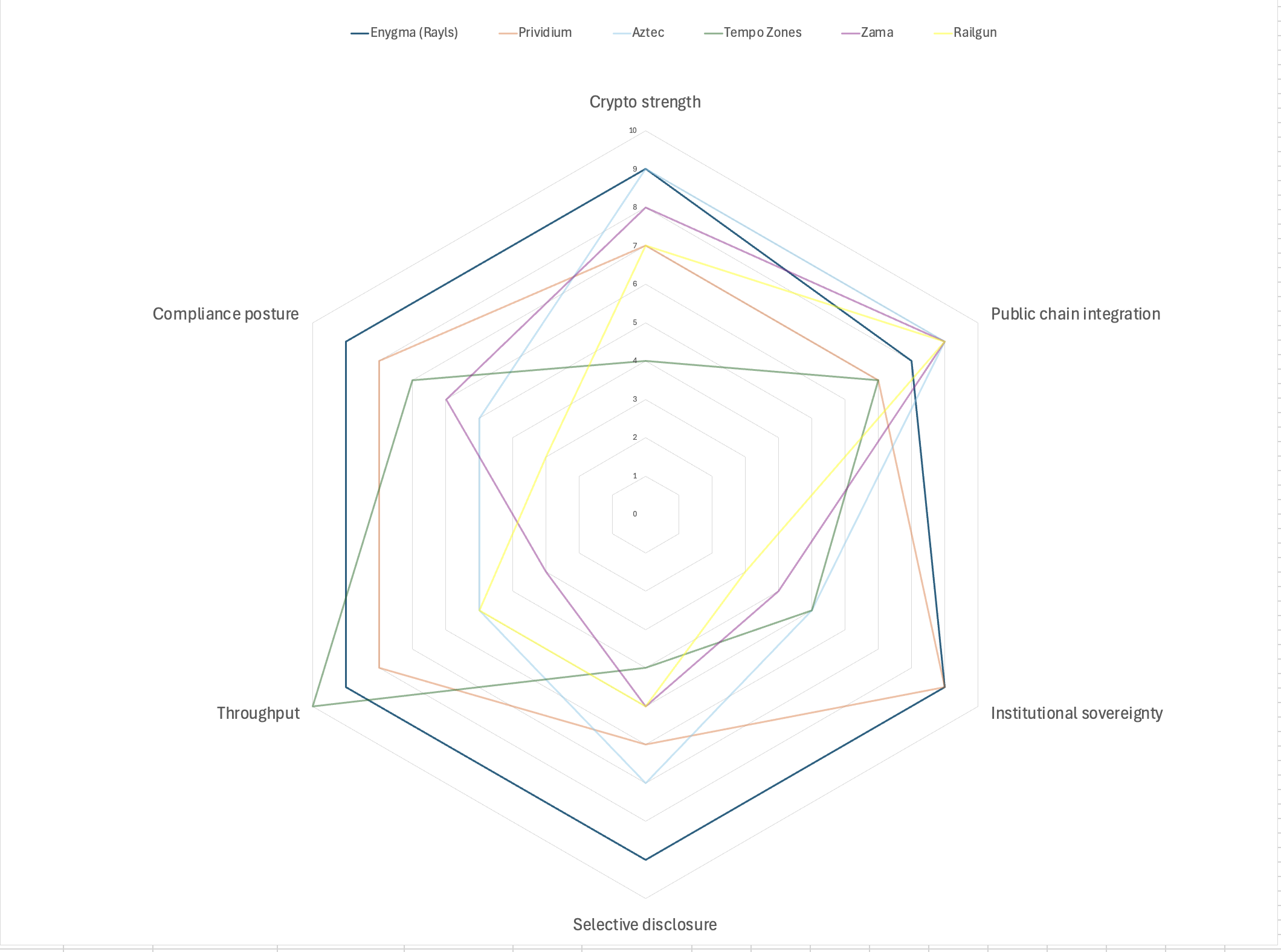
Before walking through the options, six dimensions are worth holding in mind. Different solutions weigh these differently, and that weighting is the real story.
Cryptographic approach. Whether the system is built on zero-knowledge proofs, fully homomorphic encryption, trusted execution environments, or a combination. The choice shapes what the system can and cannot do.
Architectural model. Whether the solution is a Layer 1 chain, a Layer 2 rollup, a permissioned private chain, a confidentiality layer over existing chains, or a sidechain. The architecture determines how the solution integrates with the rest of the institution's infrastructure and the public chain ecosystem.
Where the privacy boundary sits. Whether confidentiality is enforced at the institution (sovereign nodes), at the protocol operator (permissioned chains), at the application layer (privacy-aware smart contracts), or at the network (mixer-style shielding). This determines who, ultimately, is trusted with the data.
Auditability model. Whether the system supports mathematically enforced selective disclosure, hardware-attested audit interfaces, policy-based access control, or none of the above.
Performance characteristics. Honest throughput and latency at the specific privacy level the use case requires, not headline numbers measured on workloads the institution will never run.
Regulatory and compliance posture. Whether compliance is built in, bolted on, fought against, or absent. The institutions buying privacy infrastructure are operating in regulated environments that are themselves shifting fast: DORA, MiCA, the GENIUS Act, MAS Project Guardian, BACEN Drex, Project Agorá. The relationship a privacy solution has to that environment is a first-order procurement question.
These six dimensions are not equally important for every buyer. A retail-facing protocol cares about different properties than a central bank. The honest framing is to start by clarifying which dimensions are non-negotiable for the specific institutional use case, then evaluate options against those.
The credible options, walked through fairly
Zama: a confidentiality layer using FHE
Zama is an open-source cryptography company that, in late December 2025, launched the Zama Confidential Blockchain Protocol on mainnet. The protocol is a cross-chain confidentiality layer that brings fully homomorphic encryption to existing Layer 1 and Layer 2 blockchains, allowing smart contracts to operate on encrypted data without ever decrypting it. As of early 2026 the protocol reports over $120 million in Total Value Shielded, with confidential transaction costs in the cents range and partnerships including J.P. Morgan's Project EPIC.
The problem Zama is solving is computation without exposure. The architecture is FHE-first: smart contracts compute on ciphertexts, with a coprocessor model that offloads the FHE computation from the base chain to keep gas costs low and the architecture scalable. Solidity-style developer ergonomics (with euint types and similar primitives) lower the barrier to entry significantly. Programmable decryption rules are part of the protocol, which the team frames as the compliance-friendly piece.
What it does well: the FHE approach is unique among production systems today and genuinely solves a class of problems no other approach handles cleanly. Confidential AMMs, sealed-bid auctions, encrypted lending positions, and the broader category of "Dark DeFi" applications are genuinely enabled by Zama in ways they were not before.
Where the institutional buyer should look carefully: performance. The protocol publicly reports approximately 20 TPS per chain in its current implementation, with goals of 500 to 1,000 TPS by end of 2026 via GPU acceleration and a longer-term aspiration of 100,000+ TPS via dedicated FHE ASIC hardware. For high-volume institutional settlement, current and even near-term roadmap performance leaves the buyer making architectural trade-offs.
The other dimension to examine carefully is the auditability model. Zama's "programmable compliance" through decryption rules is real, but it sits at the protocol level rather than at the cryptographic-construction level. As discussed in earlier posts in this series, the security of FHE-based systems typically concentrates authority and visibility in the same key. The separation of spending authority from visibility (the spending key versus viewing key model) is not native to FHE. It can be added at the application layer, but the additions are systems work, not primitives.
For a buyer whose primary problem is confidential DeFi computation, Zama is increasingly the obvious choice. For a buyer whose primary problem is regulated bank-to-bank settlement with mathematically enforced selective disclosure, the architecture has to be evaluated against requirements it was not specifically built to satisfy.
Railgun: privacy infrastructure for DeFi users
Railgun is a privacy system built directly on Ethereum, BSC, Polygon, and Arbitrum, using zk-SNARKs to allow users to shield assets into private balances and interact with DeFi protocols without exposing the transaction trail. Since launch in 2021 it has processed over $4 billion in private transactions and gained significant momentum after Vitalik Buterin's October 2025 endorsement and integration into the Ethereum Foundation's Kohaku privacy wallet framework.
The problem Railgun is solving is shielded DeFi for end users and protocols. The Privacy Pools mechanism (which provides cryptographic proofs of innocence, allowing users to demonstrate their funds did not originate from known illicit sources) is a genuine compliance innovation that distinguishes Railgun from older mixer designs.
What it does well: it brings privacy to existing DeFi infrastructure without requiring new chains or migrations. Users of MetaMask-style wallets can shield assets, interact with major DeFi protocols, and selectively disclose for compliance. The Proof of Innocence approach is technically clever and addresses real regulatory concerns about mixer abuse.
Where the institutional buyer should look carefully: this is a DeFi privacy protocol for users, not an infrastructure for regulated institutions to settle commercial flows. The use cases Railgun excels at (shielded trades, private DeFi positions, retail privacy) are not the use cases that drive institutional procurement decisions. Beyond that, the broader regulatory environment for protocols of this category remains contested. The EU's planned 2027 privacy coin framework, the delisting of RAIL from several major exchanges, and the incidents in which protocols of this type have been used by malicious actors (including high-profile theft laundering) are all part of the institutional risk calculus.
Railgun's institutional applicability is not zero. There are scenarios where a regulated entity might want shielded DeFi exposure with proof-of-innocence compliance. But it is not the same product category as bank-grade settlement infrastructure, and treating it as such would be a category error in either direction.
Prividium: a permissioned private chain anchored to Ethereum
Prividium, launched by ZKsync in May 2025, is a permissioned blockchain framework that allows institutions to operate a private chain within their own infrastructure or cloud while anchoring every transaction to Ethereum for security and finality. The first major deployment is with Deutsche Bank's DAMA 2 platform, which originated from Singapore's Project Guardian and is the institutional use case for tokenised fund issuance, distribution, and servicing. The product is positioned as "the bank stack of Ethereum."
The problem Prividium is solving is private execution with public anchoring. Transactions execute within the institution's permissioned ledger, where the underlying data stays. Periodically, zero-knowledge proofs of the validity of the state transitions are anchored to Ethereum, providing trustless verification without exposing the underlying data. KYC, KYB, and AML controls are built into the access layer. The architecture is what the industry calls a "private validium."
What it does well: it is genuinely institutional in its design. The Deutsche Bank deployment is real and substantial. The combination of permissioned private execution and trustless public anchoring is architecturally sensible for institutions that want Ethereum security without exposing operational data. The compliance integration is built in at the protocol level rather than added afterwards. Of the options in this list, Prividium and Enygma are the two that are most clearly designed for the same buyer category.
Where the institutional buyer should look carefully: the privacy model. Prividium provides privacy by keeping the sensitive data off the public chain entirely, inside the institution's permissioned environment. This is a strong model for protecting transaction data from public exposure, but it is a different model from mathematically enforced selective disclosure within a shared network. In Prividium, the institution's permissioned operator decides who within the institution sees what. In Enygma, the cryptographic construction of viewing keys enforces that boundary mathematically, including to external regulators and counterparties on the shared network.
The second dimension worth examining is the integration model with the wider ecosystem. Prividium chains are designed for an institution to operate as their own permissioned environment with Ethereum as the anchor. Enygma's architecture is designed for a network of institutional Privacy Nodes that interact through a public chain, with cross-institutional confidentiality enforced cryptographically. The two are not the same shape, and the right choice depends on whether the institutional use case is primarily intra-institutional with public anchoring, or primarily inter-institutional with cryptographically enforced privacy across the network.
Tempo Zones: confidential parallel chains for stablecoin payments
Tempo is the Layer 1 blockchain incubated by Stripe and Paradigm, with mainnet launched in March 2026 and a substantial roster of design partners (Visa, Mastercard, Deutsche Bank, Standard Chartered, Revolut, Nubank, Shopify, Anthropic, OpenAI). The blockchain is purpose-built for stablecoin payments at scale, with claimed throughput of over 100,000 TPS and sub-second finality. In April 2026, Tempo introduced Tempo Zones, a privacy feature that lets enterprises run parallel permissioned blockchains connected to the Tempo mainnet, targeting payroll, treasury management, and payment settlements.
The problem Tempo Zones is solving is confidential stablecoin payments for specific enterprise use cases. The architectural model is a private execution environment, managed by a trusted entity for each Zone, connected to the Tempo mainnet for shared liquidity. The team has framed this explicitly as a pragmatic trade-off: stronger privacy than fully public chains, less operational complexity than fully shielded systems, and continued access to shared liquidity.
How the architecture actually works. Despite the parallel-chain framing, Tempo Zones are not zk-rollups in the technical sense. They are permissioned parallel chains attached to Tempo Mainnet, with batched state updates and proofs verified periodically by the public network. The closer architectural analogy is a validium or a permissioned sidechain with a bridge to the mainnet, rather than a ZK-rollup where every transaction's validity proof is posted to the public chain. Based on publicly available documentation as of mid-2026, the precise verification mechanism for Zone state updates has not been fully specified, but the model is clearly anchored: assets remain locked in mainnet contracts under user-owned keys, and the Zone operator manages execution without controlling the underlying assets.
The flow is divided into discrete steps. A typical enterprise payment moves through the system as follows. First, the institution onramps to Tempo Mainnet through one of the supported issuers, holding stablecoins on the public network. Second, the institution funds a Zone contract on Tempo Mainnet, which locks the assets at the mainnet level and surfaces them as available inside the Zone. Third, transactions inside the Zone (payroll runs, treasury movements, settlement legs) execute privately on the parallel permissioned chain, with no transaction data visible to outside parties. The Zone operator processes these transactions and maintains the shielded state. Fourth, Zone state updates and proofs are posted back to Tempo Mainnet on a periodic basis, anchoring the Zone's history to the public network. Finally, to exit the Zone, a recipient withdraws assets back to Tempo Mainnet, where they become available for swaps, off-ramps, or movement to other Zones. The lockup-and-prove pattern preserves the constraint that the Zone operator cannot move assets without user authorisation, while keeping the operational details of intra-Zone transactions confidential.
What it does well: the stablecoin-payment focus is sharp. The partner roster is exceptional. The performance is, by current standards, very high. For a payroll provider that wants to use stablecoins without broadcasting individual salaries on a public chain, or a payment processor that does not want to leak merchant settlement volumes, Tempo Zones is a credible production option in a way few alternatives are today.
Where the institutional buyer should look carefully: the privacy model. Each Zone is "managed by a trusted entity." This is policy-based access control with strong operational design, not mathematically enforced selective disclosure. The boundary is enforced by the Zone operator. For payroll and merchant settlement, where the trust model maps naturally onto an existing service provider relationship, this can be entirely appropriate. For bank-to-bank settlement involving multiple sovereign institutions and external regulators, the model requires more thought about who the "trusted entity" is and whether all parties to the flow accept the same trust assumption.
The other dimension is the cryptographic primitive. Tempo Zones, based on publicly available documentation, does not use ZK proofs as the privacy primitive in the way that Enygma, Prividium, and Aztec do. The privacy comes from the Zone operating as a permissioned parallel chain rather than from a cryptographic shielding of transactions on a shared chain. This is a different architectural choice with different trade-offs, neither universally better nor worse.
Comparison with Rayls Sovereign. The architectural shape is similar (a private execution environment connected to a shared settlement layer), but the underlying model diverges on several axes that matter for regulated institutional finance.
Who holds the assets and operates the infrastructure. In Tempo Zones, assets are locked in a Zone contract on Tempo Mainnet, and the shielded state lives in the parallel permissioned chain operated by the Zone operator (an enterprise or an infrastructure provider). The Zone operator processes transactions and has visibility into the shielded state, even though it cannot move the underlying assets. In a Rayls Privacy Node, the institution itself holds its own data, keys, and state natively, inside its own infrastructure. There is no lockup mechanism and no separate operator role: the institution is the sovereign holder of the data because the data lives where the institution holds it.
The trust assumption. Tempo Zones place the trust in the Zone operator, with the constraint that assets at the mainnet level are protected by user-owned keys. The operator sees the transactions; the assets remain safe from operator misbehaviour. The Rayls model places the trust in the cryptographic construction of the Enygma protocol: cross-institutional confidentiality is enforced mathematically through the spending-key versus viewing-key separation, not through an operator's commitment to honour access boundaries. The boundary is a property of the cryptography rather than an obligation of the operator.
The audit and selective disclosure model. Tempo Zones inherit issuer-defined compliance controls from the asset layer (whitelisting, freeze) which are enforceable across Zones. Audit happens at the Zone level under whatever policies the operator and the participants agree to. The Rayls model provides cryptographically enforced selective disclosure: a regulator or external counterparty can be issued a viewing key scoped to specific accounts, time windows, or asset classes, with no operator standing between them and the institution and no policy that an operator could be pressured to override.
Cross-institutional confidentiality. Tempo Zones address privacy within a Zone. Cross-Zone settlement happens at the Mainnet level through the asset lockup and bridging mechanism, where assets become visible on the public network during the transit between Zones. The Rayls model is designed precisely for the cross-institutional case: each institution operates its own sovereign Privacy Node, and the Enygma protocol provides cryptographically enforced confidentiality across the Rayls public chain when assets and obligations move between sovereign nodes. The two institutions can settle without exposing the transaction details to each other beyond what is necessary for the settlement, and without exposing them to the public network at all.
Workload focus. Tempo Zones is purpose-built for stablecoin payment workflows (payroll, treasury, merchant settlement) where the trust model maps onto existing operational relationships and the throughput requirements are very high. The Rayls Privacy Node is designed for general institutional settlement infrastructure (interbank transfers, delivery-versus-payment, tokenised deposits, cross-border settlement) where cryptographic enforcement of selective disclosure is the non-negotiable requirement and throughput is honestly bounded by the cost discussed in Post 5.
Neither model is universally better. Tempo Zones is the right answer for an enterprise that needs operationally simple confidential stablecoin payments at very high throughput, with a trust model that maps onto an existing service provider relationship. The Rayls Privacy Node is the right answer for an institution that needs sovereignty over its own data, mathematically enforced selective disclosure across a network of peer institutions, and the architectural durability that comes from cryptographic rather than operational trust.
Aztec Network: a privacy-native zkRollup
Aztec is a privacy-first zkRollup on Ethereum, with mainnet activated on 20 November 2025 after a multi-year build that included inventing the PLONK proving system. The architecture is distinctive: smart contracts have dual state (private and public), and developers can compose between them using Noir, Aztec's privacy-native programming language. The protocol is designed around "privacy by default, verifiable execution" rather than privacy as an opt-in shielded layer.
The problem Aztec is solving is privacy-native application development on Ethereum. The architecture allows a DEX to have private order books with public settlement, a lending protocol to maintain confidential positions with transparent liquidation thresholds, and similar designs that other architectures struggle to express cleanly. Noir lowers the developer barrier significantly compared to writing ZK circuits by hand.
What it does well: the depth of privacy integration is unmatched among general-purpose execution environments. The combination of programmable privacy at the application layer, the strong ZK foundations, and the Ethereum security base makes Aztec the strongest current option for developers building genuinely privacy-native applications. The community-first TGE in February 2026 and the Noir 1.0 release signal a maturing platform.
Where the institutional buyer should look carefully: Aztec is a developer platform first, not an institutional settlement system. The privacy primitives are excellent, but the institutional-grade selective disclosure model (scoped viewing keys for regulators and auditors, the spending-key versus viewing-key separation with cryptographic enforcement of audit scope) is something a developer would need to build on top of the Aztec primitives rather than something the protocol provides natively. For a bank evaluating a complete institutional settlement infrastructure, Aztec is part of the toolkit, not the solution. For a builder constructing a privacy-native application that institutions might use, Aztec may well be the strongest available foundation.
Brief notes on others
Aleo is a privacy-first Layer 1 (not a Layer 2 on Ethereum) with its own programming model (Leo) and snarkOS consensus. It is closest in conceptual position to Aztec but as an independent chain rather than an Ethereum L2. The trade-off is sovereignty versus ecosystem integration: Aleo has more architectural flexibility but is not directly composable with the Ethereum ecosystem where most institutional tokenisation currently happens.
COTI uses garbled circuits as its privacy primitive, a cryptographic technique distinct from ZK, FHE, and TEEs. The V2 mainnet launched in 2025 and has accumulated transaction volume in the hundreds of millions, with active partnerships including the Bank of Israel, the European Central Bank, and the Enterprise Ethereum Alliance. The 2026 strategy is multi-chain "Privacy-on-Demand," extending Garbled Circuits as a cross-chain privacy layer rather than a single-chain product, with private real-world assets and private DeFi as the targeted application categories. A ZK rollup component (Nightfall) is also being added alongside the Garbled Circuits stack for a dual-privacy approach.
Midnight is the Cardano-affiliated privacy partner chain engineered by Input Output Global (IOG), with the federated mainnet launched on 31 March 2026. The architecture uses a dual-token model: NIGHT is the fixed-supply governance token, and DUST is a separate shielded token that pays transaction fees and is generated by holding NIGHT. This deliberately decouples transaction cost from token price volatility, which is intended to give enterprise users predictable operational economics. The "rational privacy" model targets selective disclosure and regulatory compliance directly, with Google, Vodafone, MoneyGram, and Blockdaemon participating as federated node operators. It is worth tracking as the Cardano ecosystem's institutional privacy answer, though the transition from federated mainnet to a decentralised validator set is still ahead and the production application footprint is still developing relative to the Ethereum-aligned alternatives.
Where Enygma sits
The walk through above is intended as fair description, not as setup for a sales pitch. But the question of where Enygma fits in this landscape is the one most readers will want addressed, so it is worth answering directly.
Enygma is built for a specific institutional position. The privacy boundary sits at the institution: each participant in the network runs a sovereign Privacy Node that holds its own keys, its own data, and its own state. Cross-institutional settlement runs through the Rayls public chain, with confidentiality enforced cryptographically by the Enygma protocol layer rather than by an operator's access policy. The auditability model is mathematically enforced selective disclosure: the spending key and the viewing key are cryptographically distinct credentials, and viewing keys can be scoped to specific accounts, time windows, and asset classes. The architecture is modular, with the cryptographic components chosen for each of the four properties of institutional privacy (confidentiality, anonymity, scalability, auditability) and designed for replacement as standards evolve. Five of seven cryptographic components are already quantum-resistant. The protocol is specified in two peer-reviewed papers on the IACR cryptology archive.
This is a specific position, not a universally best position. For an institution whose primary need is confidential DeFi computation, Zama is likely a better match. For a developer building privacy-native applications, Aztec is likely a better match. For a payroll provider that needs operationally simple confidential stablecoin payments, Tempo Zones is likely a better match. For an institution that wants a permissioned private ledger anchored to Ethereum without cross-institutional confidentiality on a shared network, Prividium is likely a better match.
For an institution whose primary need is regulated bank-to-bank settlement with cryptographically enforced selective disclosure, post-quantum readiness across the cryptographic stack, and live deployment in a production environment (the Drex pilot is the most prominent example), the institutional position Enygma occupies is the one few alternatives currently match.
The honest claim is that the institutional privacy market is now large enough, mature enough, and specialised enough that no single option dominates on every dimension. The institutions that succeed in their procurement will be those that started by clarifying which dimensions are non-negotiable, then evaluated options against those, rather than starting from the marketing positioning of a single vendor.
How to evaluate an option, starting from the institutional use case
Six questions, drawn directly from the dimensions above, are the right place to start.
What is the primary problem the institution is trying to solve? Confidential payments to known counterparties? Privacy-preserving DeFi exposure? Tokenised fund issuance and servicing? Regulatory-grade selective disclosure across multiple jurisdictions? The answer determines which dimensions matter.
Where does the institution need the privacy boundary to sit? With the institution itself, with the protocol operator, with the application developer, with the network? A sovereign-node model and a permissioned-ledger model both deliver privacy, but they are not the same kind of privacy.
What is the audit and disclosure obligation? Selective disclosure to multiple regulators with different scopes is a hard requirement that few systems support natively. If this is non-negotiable, the cryptographic construction of the audit interface is the property to examine.
What is the required throughput at the privacy level the use case demands? Headline TPS numbers tell you little until you specify the workload. The right question is throughput at full shielding, with audit support, on a workload that resembles the institution's actual usage.
What is the quantum readiness across the cryptographic stack? Not a single algorithm. Every component. Vendors who can answer this precisely, component by component, are vendors whose security posture has been thought about carefully.
What is the production track record with regulated institutions? Pilot deployments, live customers, and academic publications are not the same thing, but together they tell a story about whether the system has been tested against real institutional requirements or only against benchmarks.
A vendor whose answers to these six questions are specific, honest about limitations, and verifiable against external sources is a vendor whose claims survive procurement scrutiny. A vendor whose answers depend on marketing language and abstraction is a vendor whose performance under stress is not yet visible.
Subscribe to our newsletter

