Rayls Enygma Public testnet pilot: Private payments. Safe and compliant.

Today we're opening the public testnet pilot of Rayls Enygma Public, a privacy protocol for EVM chains that hides who paid whom and how much, encrypts it with post-quantum ML-KEM, and keeps an auditor in the loop by design. It's live today at enygma-testnet.rayls.com.

Why we built Rayls Enygma
Rayls has worked with banks for years, and one blocker comes up every time they look at public blockchains: privacy. A bank can't let its competitors see its transactions. Yet the law requires that its regulator and auditors can.
We felt this most sharply working with the Central Bank of Brazil on its Drex pilot. So we built Enygma: a set of quantum-private cryptographic protocols for shielded balances and private payments. The code is public on GitHub.
On a public chain, anyone can see that an Enygma payment happened. Nobody can see who paid whom, or how much, unless they hold the auditor key. Amounts and recipients are encrypted with AES-256-GCM (the encryption that also protects secure websites), under keys agreed through ML-KEM (which lets your wallet share a secret key with the recipient and the auditor that even a quantum computer couldn't crack), the post-quantum key exchange standardised by NIST (the US government's standards agency), and derived with HKDF (which turns that shared secret into the encryption key), so they stay hidden even from a future quantum computer.
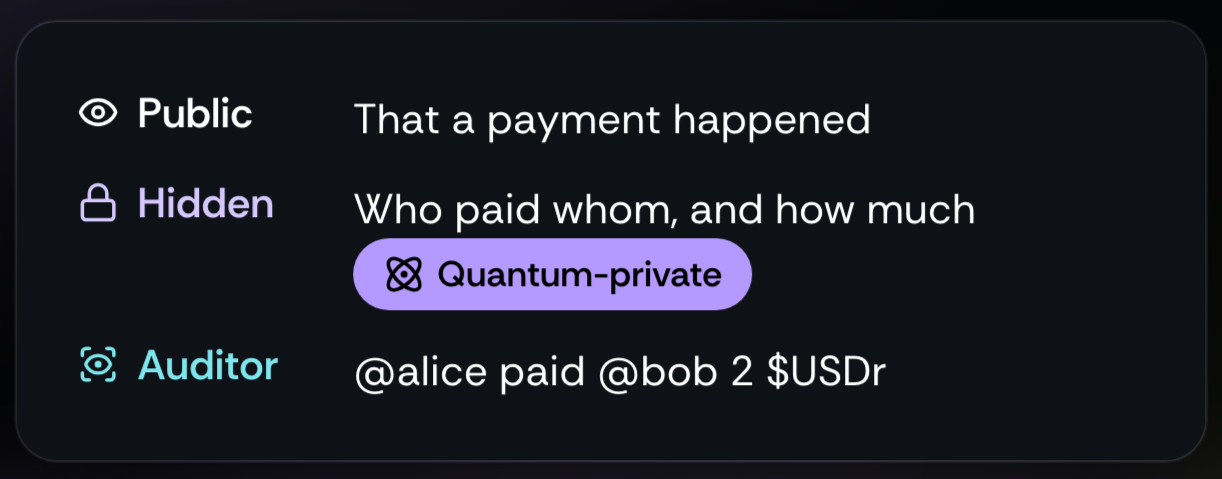
Rayls Enygma comes in two editions. Enygma Sovereign connects banks' own chains and is in production today. This testnet pilot runs the new Enygma Public, built for public chains: payments sit in one shared shielded pool, and a relayer submits each one, so the sender's address isn't in the transaction. Due to the encryption methods used, the relayer also does not know the contents of the transaction. Moving tokens into the shielded pool and out of it is public.
From banks to everyone
Today we're taking the next step: opening this work up and bringing it to our wider community to experiment with.
The new Enygma Public testnet pilot is live at enygma-testnet.rayls.com, on the Rayls Public Chain Testnet. It uses test tokens only, so nothing you send there has real value.
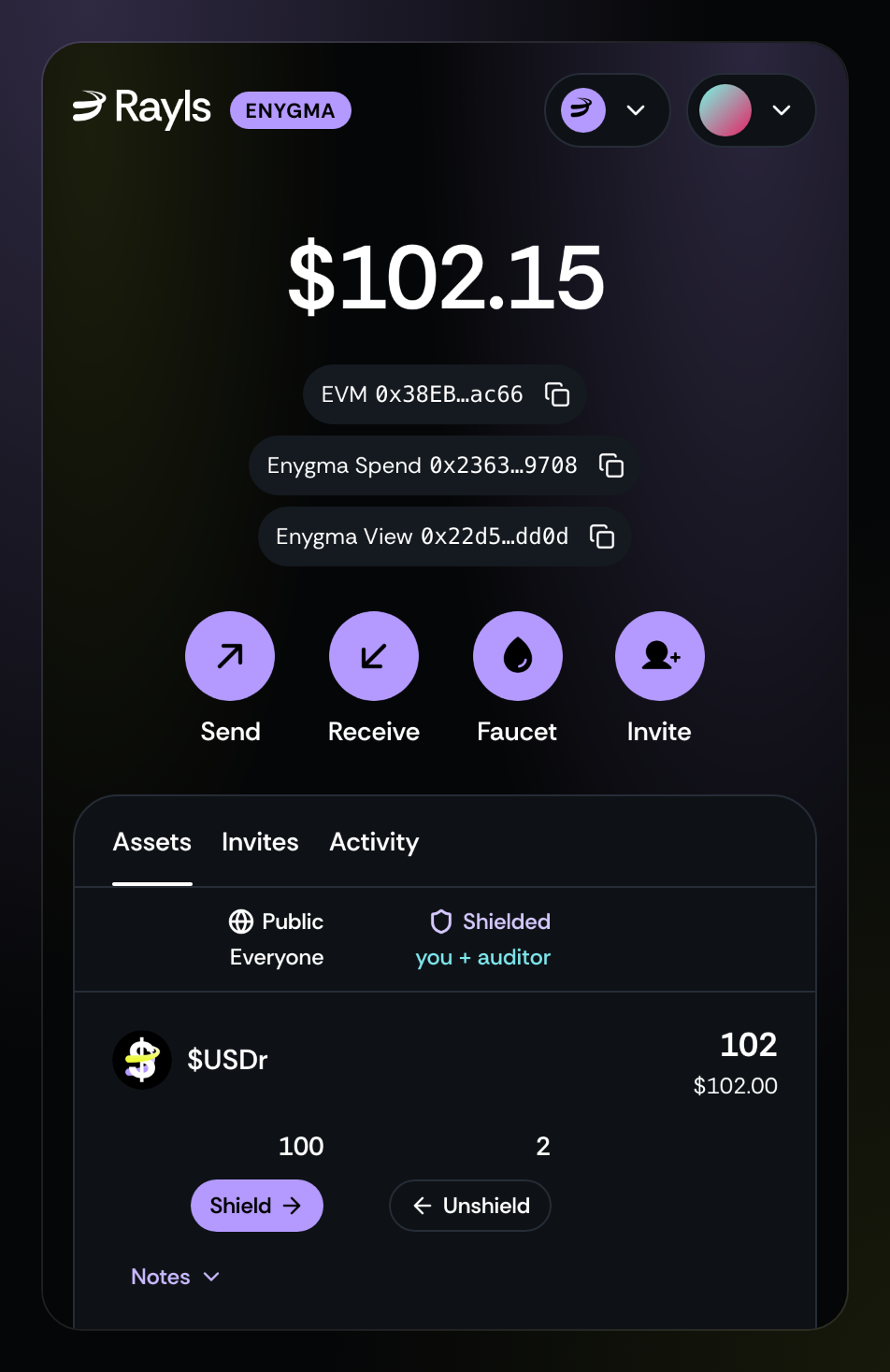
Try Rayls Enygma Public in three steps
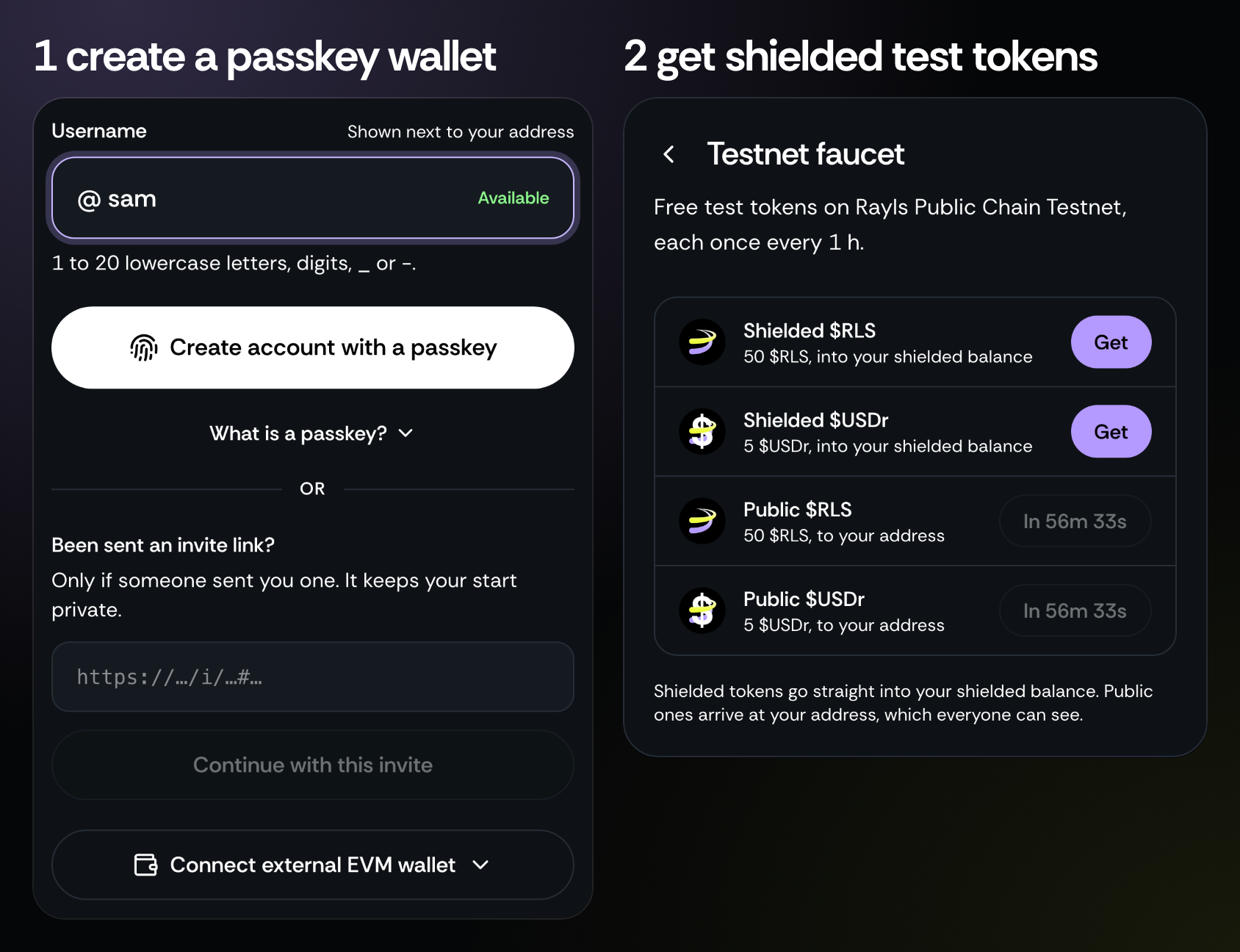
- Create a quantum-private wallet with a passkey. Pick a username and confirm with Face ID, a fingerprint or your device PIN. No seed phrase, no browser extension. The wallet then walks you through getting test tokens and registering your keys, so others can pay you.
- Get shielded test tokens. The wallet's faucet sends 50 test $RLS and 5 test $USDr straight into your shielded balance, each once an hour.
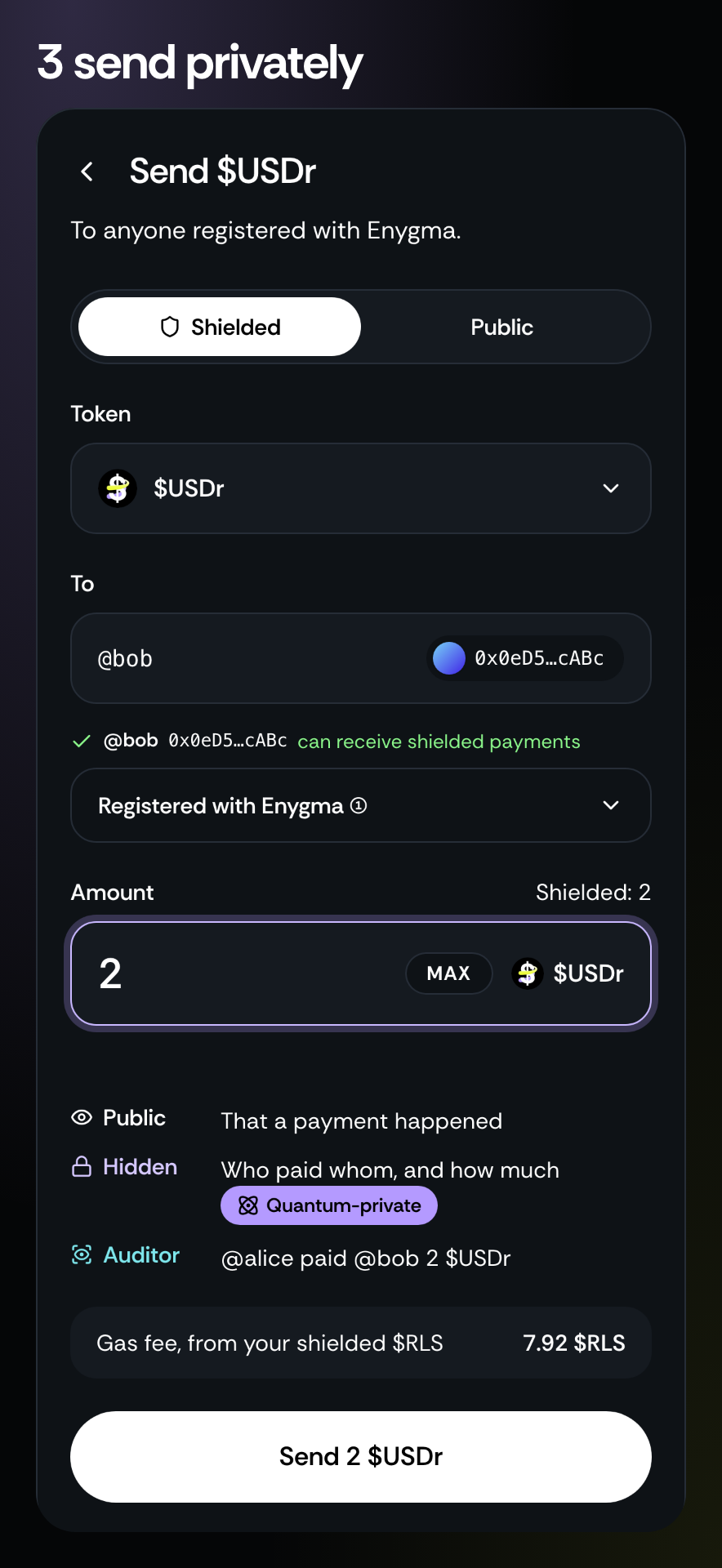
- Send a private payment. Choose someone by username and send. Each send shows its gas fee in shielded $RLS before you confirm, and asks for your passkey again.
Invite people, and solve the first-gas problem
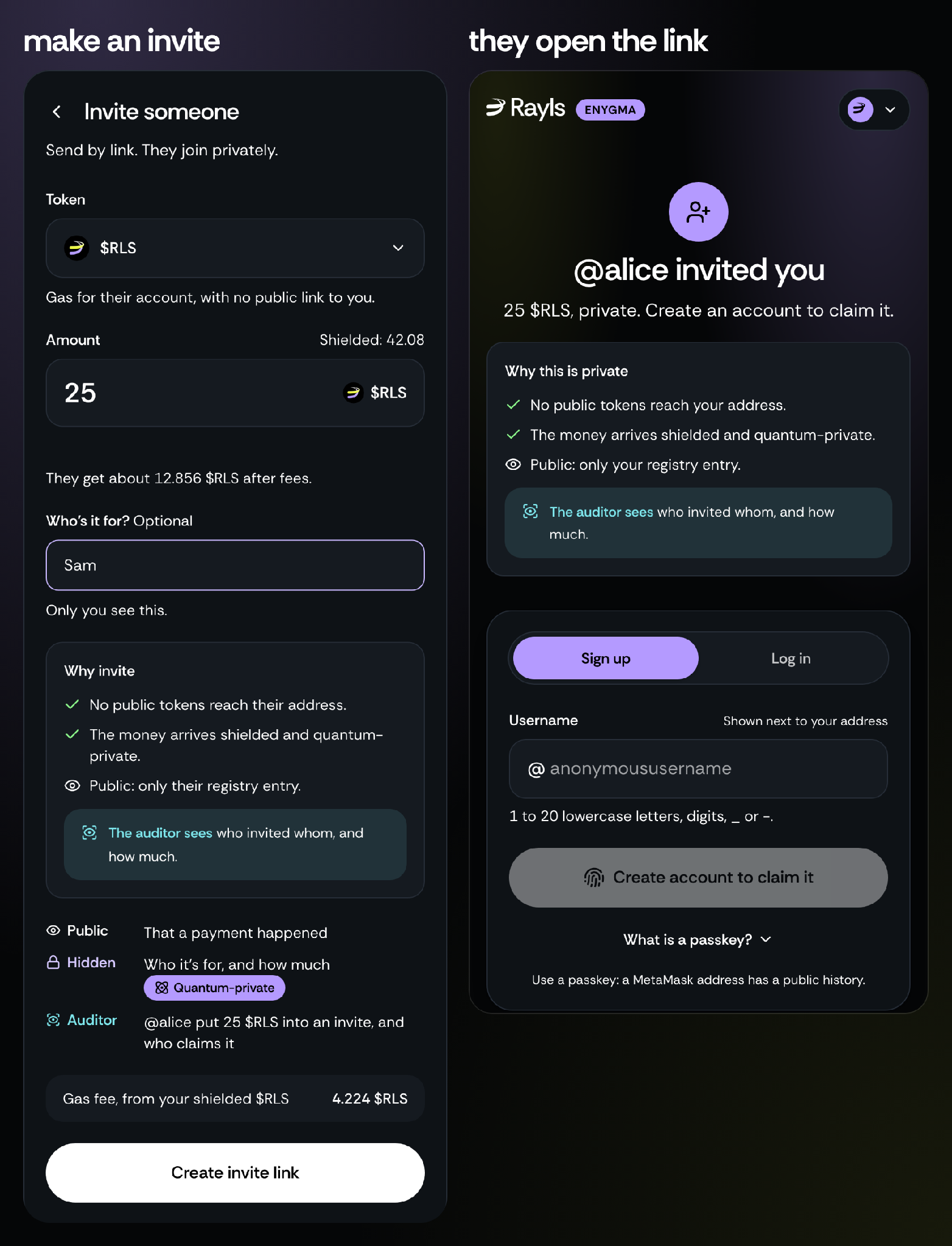
You can also invite other people. Put shielded tokens into an invite link ($RLS by default) and share it however you like. Whoever opens it gets a new Enygma account with private test tokens already in it.
This solves a problem that has long plagued privacy protocols on public chains: seeding the first gas. A new address needs gas before it can do anything, and getting that gas gives the address away. A faucet, an exchange withdrawal or a transfer from a friend links it, publicly and for good, to whoever funded it.
On Enygma, gas is paid in shielded $RLS. An invite delivers it as a private payment, and the claim pays for the newcomer's registration. Their address never sends a transaction of its own and never holds a public token. The public sees a new account in the registry, but not who funded it or with how much.
Invites also work between your own accounts: send yourself one and open it in another browser to move funds with no public link.
What Rayls Enygma Public means for $RLS
Every Enygma Public transaction pays its gas in $RLS, even a payment in $USDr (the native gas token of the Rayls Public Chain). The wallet shows the fee before you confirm, and you can pay it from your shielded $RLS, so the fee doesn't link back to your address. ($USDr stays the standard gas for everything else on the Rayls Public Chain.)
Each fee includes a 15% commission for the Rayls Foundation, paid in test $RLS on this testnet, which could change in the future. Paying gas in shielded $RLS is part of bringing more utility to the $RLS token. When this experience comes to mainnet, the Rayls Foundation plans to collect it in real $RLS. Beyond this pilot, Enygma's usage policy requires every deployment of its protocols, on any network, to charge all its fees in $RLS, unless the Rayls Foundation agrees otherwise in writing.
Passkey or your own wallet?
You can bring an existing EVM wallet, such as MetaMask, to the pilot. But its address has a public history, so you risk linking your public profile to your shielded activity.
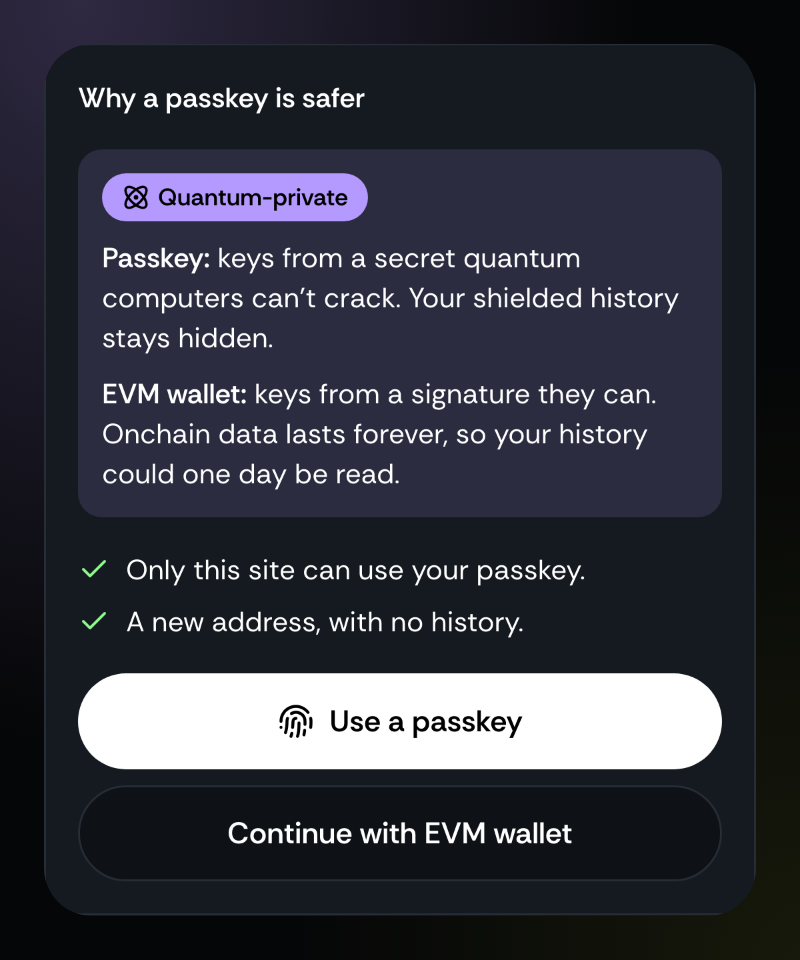
A passkey starts you on a new address with no history, and brings more benefits:
- Quantum-privacy: Enygma doesn't build your keys from the passkey's signing key (P-256), which a quantum computer could break. It uses a separate symmetric secret the passkey keeps for this site (the WebAuthn PRF extension), and only hash functions and ML-KEM stand between that secret and your shielded history. Keys made from a wallet signature can be cracked, because your address's public key is onchain after its first transaction. Like any EVM account, the public balance at your address is not quantum-safe.
- Ease of use: Face ID or a fingerprint instead of a seed phrase or an extension.
- Recovery: a passkey synced through iCloud Keychain, Google Password Manager or your password manager comes back on a new device. If you lose a passkey that isn't synced, you lose access to that account.
- Phishing: only the Enygma site can use your passkey.
Shielded from the public, not from the auditor
Remember: every transaction in this pilot can be read by whoever holds the auditor keys. For this testnet deployment, that is the Rayls Foundation. It can see who paid whom and how much, including invites.
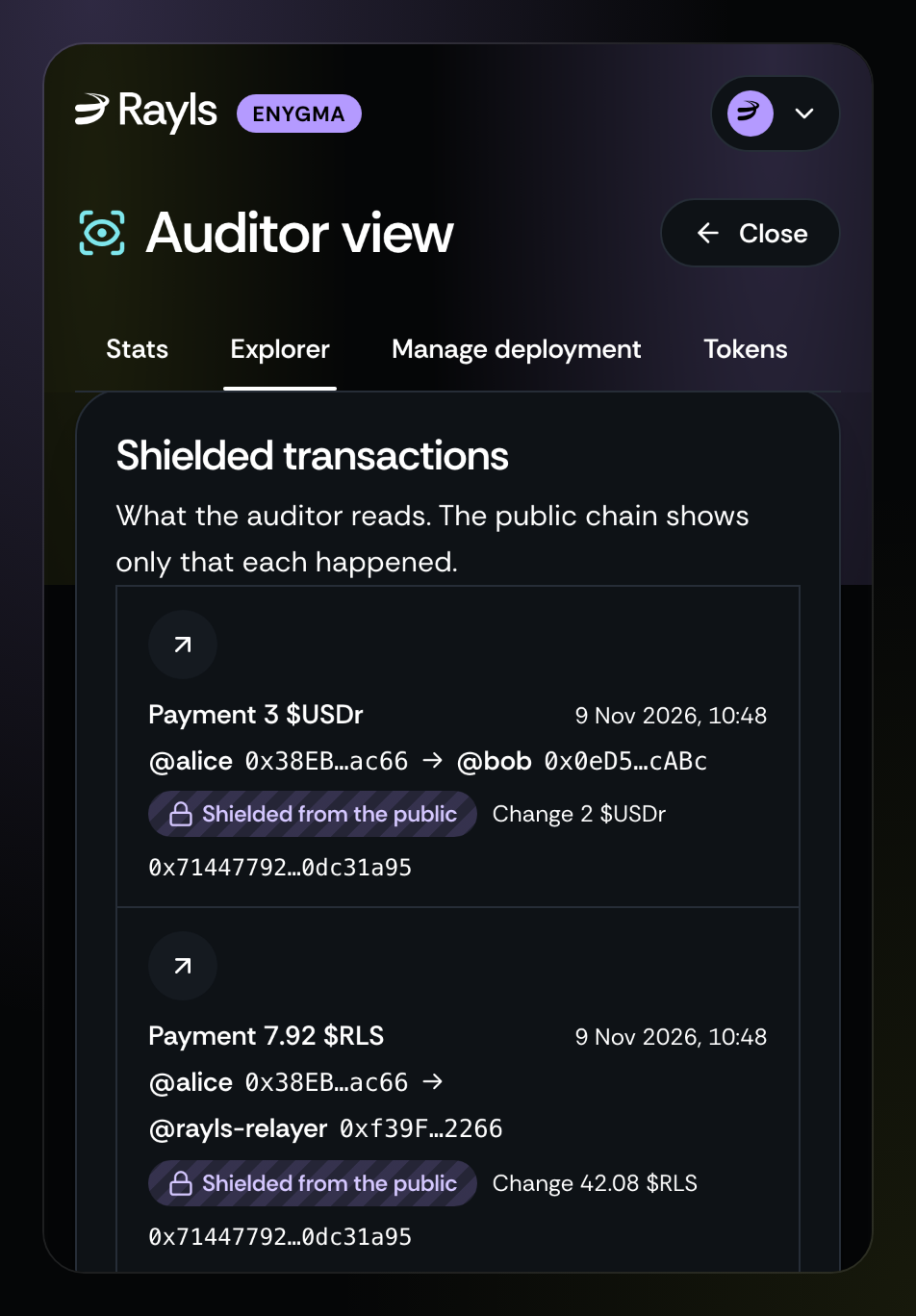
That is the point of Enygma. Your payments are hidden from the public and your competitors, while oversight stays possible. Your username and address are public in the registry, so that others can pay you.
How Rayls Enygma Public compares to Starknet, NEAR Intents, Solana Privacy Rings, Hinkal, Railgun, Zcash, Zama and Tornado Cash
From our research, Rayls Enygma Public is likely the only blockchain privacy protocol that hides amounts from the public, hides who paid whom from the public, is quantum-private, has auditor access, runs on EVM chains, creates proofs in under 4 seconds, sends transactions in under a second, and has passkey wallets.
Quantum-private, in plain terms. Everything on a public chain stays there for good, so an attacker can record it today and decrypt it once quantum computers are ready. Enygma encrypts every payment's amount and recipient, each user's view key and the auditor's copy under keys agreed through ML-KEM, NIST's post-quantum standard, so that recorded history stays private. Zama describes its encryption as post-quantum, but from what we found it leaves addresses visible. Zcash plans it, and, as far as we can tell, Starknet, Solana Privacy Rings, Hinkal, Railgun and Tornado Cash rely on elliptic curves that a quantum computer could break. We found no post-quantum claim from NEAR Intents: its privacy appears to rest on a private shard and secure hardware.
What it doesn't cover yet: Enygma's zero-knowledge proofs and the signatures that authorise transactions are not post-quantum. A quantum computer couldn't read your history, but in principle it could forge a proof, so Enygma is quantum-private, not quantum-secure. Starknet's proofs are STARKs, built on hash functions and generally considered post-quantum, which guards the chain against forged proofs, not your privacy: but from what we found, the data that would unmask a payment is still elliptic-curve encrypted.
This is our own reading of each project's public documentation as of November 2026, not a statement by those projects. Things change quickly, so check their latest docs, and tell us if we got anything wrong. Sources: Starknet privacy launch, Railgun privacy system, Zcash viewing keys, Project Tachyon, Zama Protocol litepaper and Tornado Cash on ETHBEAT. NEAR and speed figures: NEAR Confidential Intents, Starknet privacy architecture, Railgun Private POI and Zama GPU benchmark. Solana figures: Solana Privacy Rings overview, Solana Privacy Rings encryption and Solana Privacy Rings spec. Hinkal figures: Hinkal encryption, Hinkal compliance, Hinkal SDK and Hinkal supported chains.
Coming to Rayls Enygma Public in the next few weeks
Over the coming weeks we'll add more to the pilot:
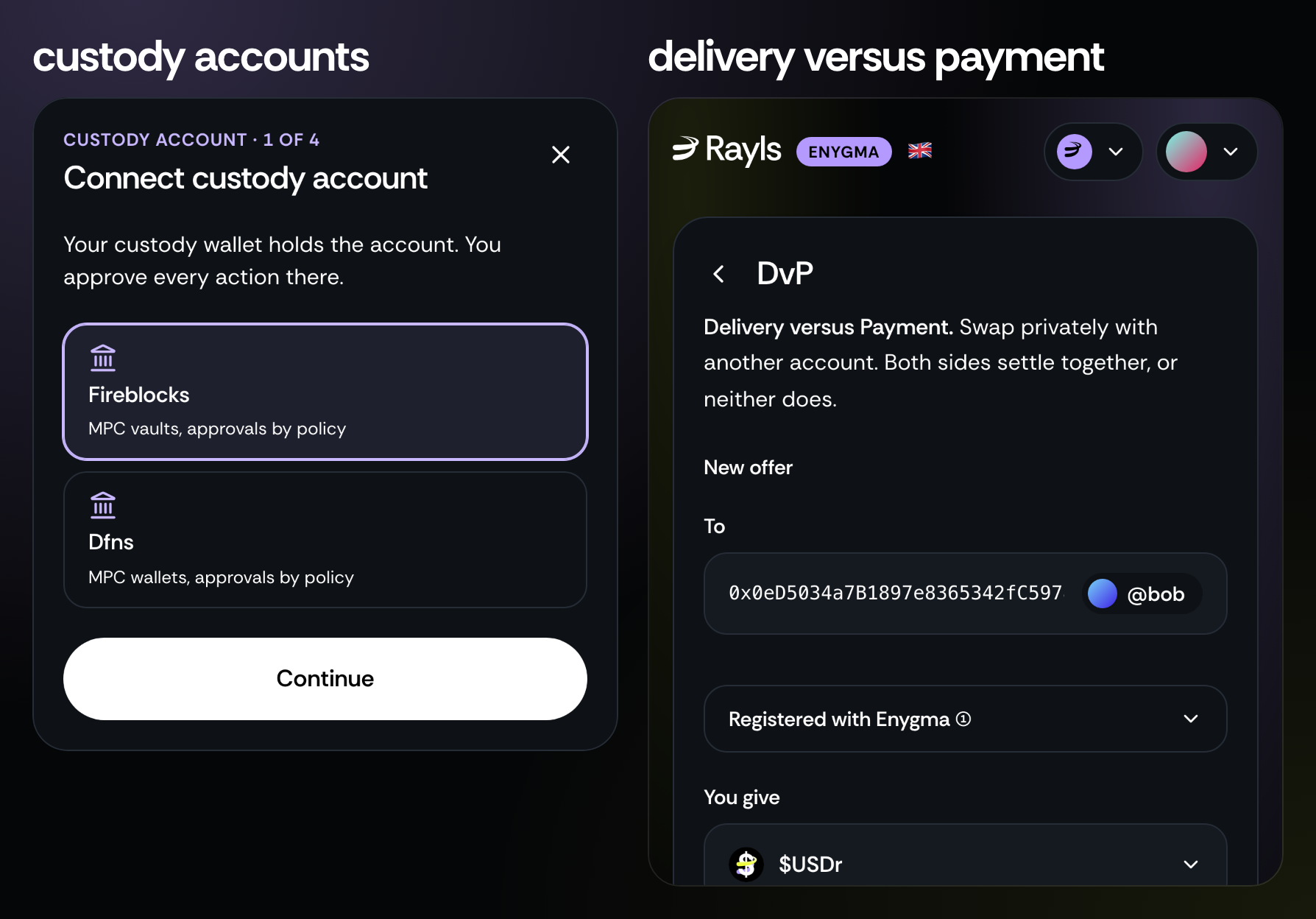
- Custody accounts through WalletConnect: connect a Fireblocks or Dfns account and approve each transaction there.
- Shielded swaps: trade one shielded asset for another.
- DvP (delivery versus payment): an asset and its payment change hands together, or not at all.
- Sealed-bid auctions: bids stay sealed until the auction closes.
Try it and tell us what you think
Until now, this technology ran out of sight, inside banks. We're excited for you to play with it, and we look forward to your feedback: what worked, what didn't, and what you'd build with it.
Start at enygma-testnet.rayls.com. Give us feedback on X or Discord.
Rayls Enygma Public FAQ
What is Rayls Enygma?
Rayls Enygma is a privacy protocol for EVM chains. It hides who paid whom and how much, while an auditor can still read every payment. It comes in two editions: Enygma Sovereign, in production between banks, and Enygma Public, which this pilot runs on the Rayls Public Chain Testnet. Enygma Sovereign connects banks' own Rayls Sovereign chains: each transfer hides its receiver among up to six banks, and the network operator, usually the central bank, can read every transfer. Enygma Public is for anyone on a public chain: payments sit in one shared shielded pool, and a relayer submits each one, so the sender's address isn't in the transaction.
Who can see my Rayls Enygma payments?
In Enygma Public, which this pilot runs, the public sees that a payment happened, but not who paid whom or how much. Your username and address are public in the registry, and moving tokens into or out of the shielded pool is public. The person you pay sees what they received. The auditor sees everything, including invites; on this testnet, that is the Rayls Foundation. It can read payments, but it can't freeze or move funds. In Enygma Sovereign, other banks and the public can't see amounts or which bank was paid, and the network operator, usually the central bank, can read every transfer.
Is Rayls Enygma quantum-safe?
Enygma Public is quantum-private: payment data is encrypted with AES-256-GCM under keys agreed through ML-KEM, NIST's post-quantum standard, so recorded history stays private even from a future quantum computer. Its zero-knowledge proofs and transaction signatures aren't post-quantum, so it isn't quantum-secure. Enygma Sovereign also uses ML-KEM, for the view keys that let the network operator read transfers.
How is Rayls Enygma different from Railgun or Tornado Cash?
From their public documentation, Tornado Cash moves fixed amounts and only breaks the link between a deposit and a withdrawal. Railgun hides payments inside its pool, but, as far as we can tell, an auditor only sees them if you share a viewing key. Enygma Public gives an auditor access by design, encrypts payments with post-quantum ML-KEM, and pays gas in shielded $RLS, so an invited account never needs public funding.
Are my payment details sent to a server?
Your spending key never leaves your device, and the wallet makes each proof in your browser. A relayer submits the finished transaction. The amount and recipient in it are encrypted, so the relayer can't read them. Like any website, it sees your IP address. The site counts page views with Google Analytics, page names only, and you can turn that off in How it works. That's the Enygma Public wallet. In Enygma Sovereign, each bank's keys stay in its own key service, and it sends through its own relayer.
What happens if I lose my passkey?
Your Enygma Public keys come from your passkey. A passkey synced through iCloud Keychain, Google Password Manager or a password manager comes back on a new device. If you lose one that isn't synced, you lose access to that account and its shielded balance, and nobody can recover it. Enygma Sovereign doesn't use passkeys: each bank's keys stay in its own key service.
Is Rayls Enygma live on mainnet?
Enygma Public isn't: this pilot runs on the Rayls Public Chain Testnet, with test tokens only. Enygma Sovereign already runs in production with banks, on their own Rayls Sovereign chains.
Subscribe to our newsletter