Rayls: the missing piece for institutional blockchain adoption at scale

In January this year I had the privilege of speaking at the Web3 Hub in Davos during the World Economic Forum 2026. As the VP of Institutional Product Adoption for Rayls, I shared my perspective on what is holding back massive institutional blockchain adoption and the missing piece that will finally connect traditional finance with decentralised finance.
For those who couldn't attend, here’s a summary of the presentation.
The institutional dilemma
While the blockchain industry has seen incredible innovation, the reality is that traditional finance still controls 99% of the global financial balance sheet and active financial services users. Today, just 1% of the world’s capital and users reside onchain. So if blockchain is to become the new global financial rails, we must build infrastructure capable of allowing institutions to bring their full operations, customers, and capital onchain.
Historically, institutions have had to compromise. Permissioned blockchains provided control but resulted in isolated, fragmented liquidity with no connection to broader capital pools. Public blockchains have shown more promise, with $33T in stablecoin volumes in 2025, solidifying regulation across the world, and technology that can scale to meet institutional demands.
But, whilst public decentralised finance (DeFi) brings programmability and global reach, its inherent transparency lacks the privacy, compliance, and regulatory safeguards necessary for institutional use.
Institutions need the best of all worlds
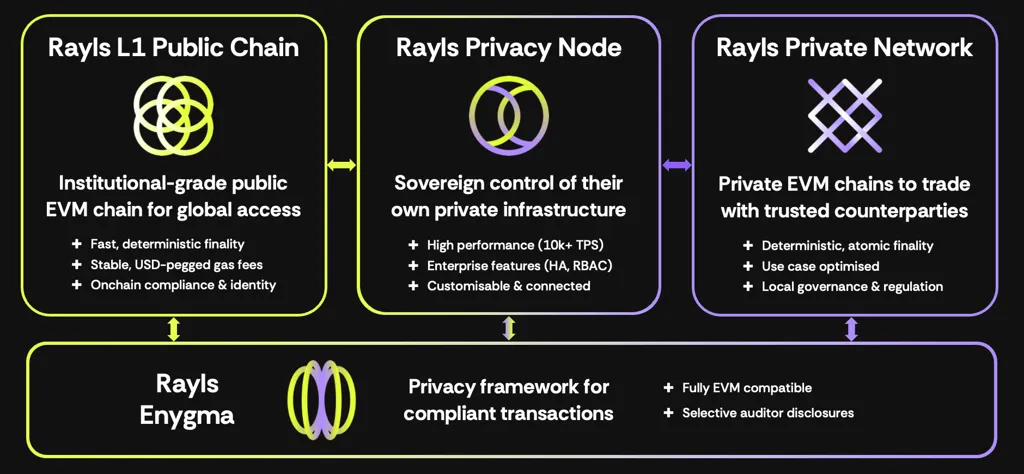
To be successful, regulated financial institutions need sovereign control of their own infrastructure, with high performance, standard enterprise features like high availability and role-based access controls, and a solution that they can fully customise and integrate with their existing systems.
They also want to access private EVM chains to transact privately with their counterparties, with atomic finality, networks that are tailored to their specific use case and governance rules that comply with local regulation.
And they also want access to public DeFi networks to access DeFi innovation and distribute their assets to suitable international investors. But even this public chain should be tailored for institutions, with deterministic finality (to prevent reorgs), stable gas fees that are pegged to the US dollar, and a range of embedded compliance and identity tools to help them meet regulatory requirements.
And finally, they want all this, but with an EVM privacy framework so they can conduct their business across these networks with anonymity and confidentiality. To stay compliant, this can’t be a black box, but rather a framework that keeps data private from competitors, while still providing selective disclosures to regulators.
This is exactly what we have built at Rayls with the Rayls Privacy Node, Private Networks, Public Chain and Enygma, each of which combine into one connected ecosystem.
The missing piece to scale?
With Rayls Sovereign, each institution runs its own ledger, inside its own environment, while connecting to other institutions through Private Networks and to public liquidity through the Rayls Public Chain.
Think of this like a tokenised core banking system that integrates with existing systems and interoperates with both private and public chains via private bridges that the institution fully controls.
And because all elements are fully EVM compatible, it enables assets to be transferred across networks with composability, creating a frictionless network of networks for tokenised assets.
Proven at scale
Rayls is not just a theoretical concept; it is already live and processing significant transaction volumes.
Rayls has been installed with the Central Bank of Brazil and 16 of the largest Brazilian commercial banks, with billions of dollars committed to be tokenised onto Rayls by some of the largest financial institutions in LATAM.
Brazil has been a strategic market for Rayls. As a high growth economy, it offers the sweet spot of financial innovation appetite, proactive regulation and a large scale population of 210 million people. PIX, Brazil’s instant payments system, is a great example of Brazil’s ability to deliver world-class financial innovation at scale.
We’re now leveraging our early success in LATAM to expand globally into other markets, such as the US, UK, Middle East and across APAC.
Subscribe to our newsletter