Rayls Tokenomics: Automated buybacks, burn, and the Rayls Reserve

At Rayls, we are building an ecosystem to combine the stability of traditional finance and crypto innovation. As we move closer to our Mainnet launch (April 2026), it is vital that we share the economic principles that underpin our ecosystem.
We have designed a tokenomics model that is not only sustainable, but actively aligns the incentives of institutional clients, validators, and our token holders.
Our approach focuses on long-term value accrual. By integrating real-world fiat revenue streams directly into an on-chain deflationary mechanism, we ensure that as adoption of Rayls Sovereign grows, the entire community benefits.
The Tokenomics model overview
The core logic of the Rayls tokenomics model is a system designed to capture value from (predominantly) institutional usage fees, redistribute this value across our DeFi community, and reduce supply to instil deflationary pressure into the token economy.
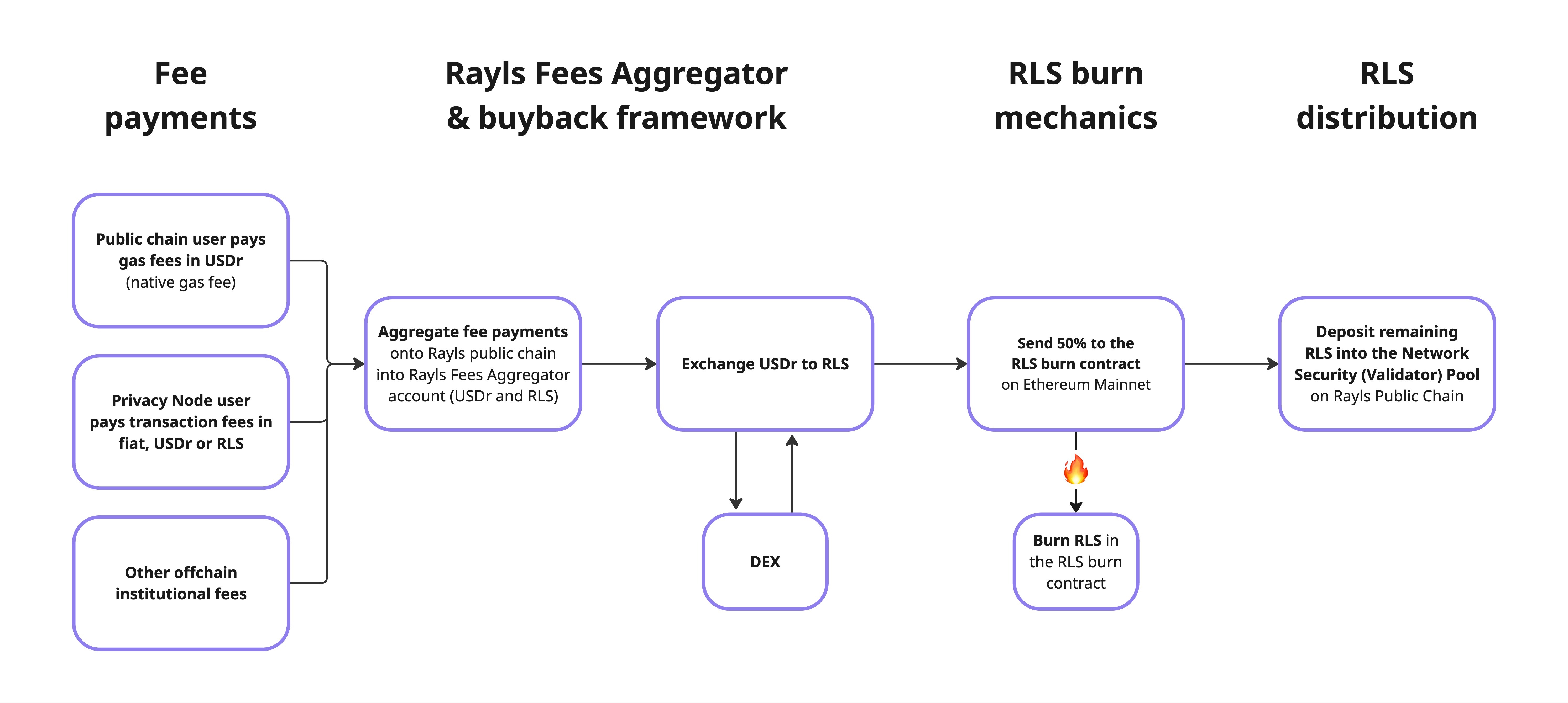
Workflow
- Fees are generated across both the Rayls Public Chain and each Rayls Sovereign (one per institution).
- Fees are aggregated into an account on the Rayls Public Chain in USDr (Rayls’ native gas stablecoin) and RLS, providing full public visibility.
- USDr fees are converted into RLS via a DEX (AMM).
- 50% of all RLS from aggregated fees is burned within the RLS burn contract on the Ethereum Mainnet (where RLS was originally minted).
- The remaining 50% of RLS that was not burned is sent to the Network Security Pool for validator rewards.
This cycle ensures that the Rayls Fees Aggregator is constantly replenished and used to purchase RLS, while a portion of that RLS is burned, creating consistent demand for the RLS token while simultaneously decreasing supply.
The timing of exchange and burn triggers are designed to weather market volatility while rewarding long-term participation.
1. Bridging Fiat to onchain value
A major friction point for institutional adoption is the requirement to hold and transact in cryptocurrency.
To solve this, Rayls allows Sovereign clients to pay transaction fees in fiat currency, USDr, or RLS. This ensures a seamless user experience for enterprise clients while preserving the on-chain economic model.
Behind the scenes, a verified Foundation OTC partner converts (off-chain) fiat fee payments into Rayls-approved tokens, specifically USDr or RLS. For USDr, this involves purchasing an equivalent amount of USDC on Ethereum, then locking this USDC to mint USDr (1:1) onto the Rayls Public Chain. These funds are then deposited directly into the Rayls Fees Aggregator account on the Rayls Public Chain.
This mechanism ensures that the value of institutional usage and activity in Rayls private chains is captured and exerts positive pressure on the Rayls ecosystem.
Verified OTC partners are brokers that operate in local markets (i.e., specific countries) to accept Rayls fees in local fiat currency and convert this value into USDr or RLS on the Rayls Public Chain.
For transparency, verified OTC partners will be carefully selected and monitored by the Rayls Foundation, and a registry of OTC partner public chain addresses will be published on the Rayls Public Chain so anyone can track the inflows of institutional fees captured from Sovereign chains.
2 & 3. The buyback engine
Once fees are aggregated, the protocol engages a robust buyback mechanism.
The Rayls Fees Aggregator holds both USDr and RLS, serving as the engine for the deflationary policy.
In the initial stages, the buyback process will be manually triggered in a regular but randomised manner (to avoid front-running).
In the future, the buyback process will be governed by a two-layer policy:
- A deterministic framework establishes “earmark eligibility” based on specific triggers such as account balance thresholds and other factors.
- The execution of swaps from USDr to RLS is randomized and spread across several smaller transactions.
This randomization protects the network from MEV (Maximal Extractable Value) bots and front-running. By executing smaller, daily swaps with strict slippage constraints, the system deepens the order book and dampens volatility rather than creating predictable spikes.
4. Burn mechanics
A key pillar of the Rayls value proposition is the reduction of total token supply over time. As such, a percentage of all RLS fee payments is automatically burned and permanently removed from circulation.
At launch, the network will begin with 50% of RLS fee payments being burned. In the future, as the ecosystem matures, the burn percentage will depend upon:
- The remaining percentage of the original RLS supply
- The price of RLS
As supply decreases and price increases, the burn percentage adjusts downward, ensuring a smooth economic curve that avoids negative price volatility.
But to reiterate, at launch and for the foreseeable future, 50% of RLS transaction fee payments will be the fixed burn rate.
The mechanism to burn will be to send 50% of the RLS from transaction fee payments to the RLS Burn Contract on the Ethereum Mainnet, giving visibility of the RLS that is pending burn. At regular intervals, RLS will be burned, permanently reducing the total supply of RLS.
5. The Rayls Reserve and distribution
Tokens that are not burned are sent to the Network Security (Validator) Pool account, to reward validators for their work to security the network.
In the future, as the ecosystem grows and matures, and only once the Network Security Pool is self-sustaining with a significant sized pool, a portion of this non-burned RLS may also be allocated to other ecosystem development and Foundation operations activities.
A maturity-based model adjusts distribution ratios as the network evolves:
- Early stages prioritize validator rewards to ensure security
- Growth stages increase ecosystem development funding
- Mature stages balance allocations across validator rewards, ecosystem development and operations.
Validator strategy
Rayls initially implements a permissioned validator set that is geopolitically distributed to mitigate political risks of collusion.
Policies ensure:
- Geographic balance
- Diversity of validator entity types
As the validator set grows and the ecosystem matures, governance will undergo a phased transition into a decentralised DAO model, with RLS token holders voting on protocol and policy changes.
Summary and next steps
The Rayls tokenomics model is designed to be robust, transparent, and deflationary.
By converting fiat revenue into on-chain buybacks and balancing token burning with strategic ecosystem funding, Rayls is building a protocol positioned for long-term longevity.
Deterministic triggers for the buyback mechanism and maturity criteria for Reserve allocations are currently being finalized. An initial version will be implemented at Mainnet launch, followed by optimizations guided by token holder voting.
More detailed technical documentation and parameters will be shared in the near future. Feedback and suggestions from the community are welcome.
Subscribe to our newsletter



.webp)