Rayls Public Chain Mainnet launch on 30th of April 2026
Rayls Public Chain Mainnet launch on 30th of April 2026: A new era for Rayls- $RLS Tokenomics and deflationary mechanisms activate
After years of dedicated development and close collaboration with institutional partners, the Rayls Public Chain mainnet is going live on the 30th of April at 3pm UTC.
This date also marks the launch of our staking program and USDr, the Rayls-native USD-backed stablecoin used for gas fee payment.
This marks a pivotal milestone for the Rayls ecosystem, the moment when the network transitions to full production, and the real tokenomics of the $RLS token begin to take effect.
With public mainnet activation, tokenomics are no longer theoretical. Gas fees generated across both private institutional chains and the new public chain will now directly influence $RLS supply through automated conversion, accumulation, burning, and redistribution mechanisms.
This creates a sustainable flywheel that rewards network usage while introducing deflationary pressure.
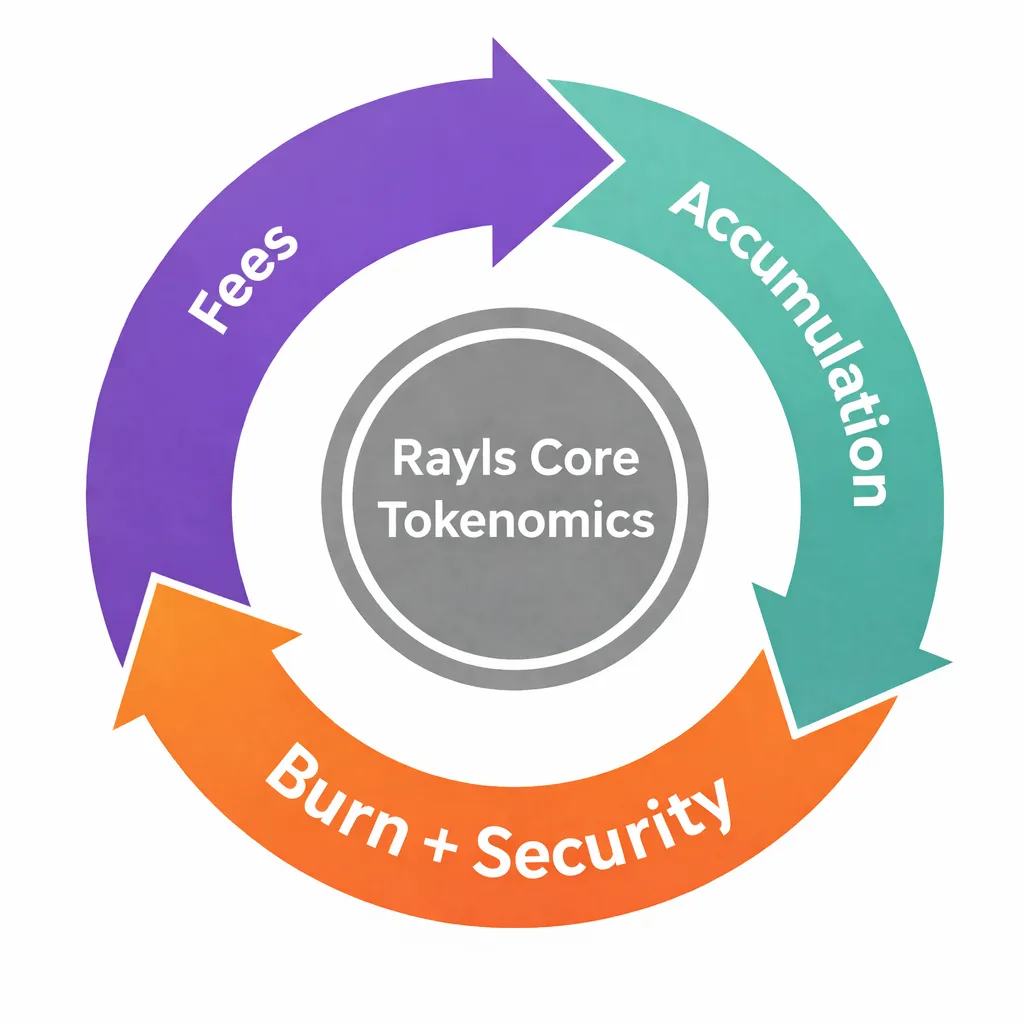
A cornerstone of Rayls tokenomics is how transaction fees are handled. Fees collected on the public chain (paid in the native USDr stablecoin) and on private chains (where $RLS can serve as gas) are aggregated and converted into $RLS where necessary. These tokens flow into a dedicated Treasury Accumulation Address (also referred to in documentation as part of the Rayls Reserve system). You can see the onchain address and real-time balance in the Rayls transparency portal.
This address acts as a transparent, on-chain buffer. Funds sit there for a short period (typically a few weeks), allowing for full public visibility and verification. Then, an automated process triggers: 50% of the accumulated RLS is permanently burned, reducing the total circulating supply and creating scarcity as network activity grows.
The remaining 50% is transferred to the Network Security Pool. These funds help compensate validators who secure the network through staking and consensus participation.
In the early stages of mainnet, fee generation may not yet fully cover validator rewards. During this ramp-up phase, the Rayls Foundation will supplement payments from its own treasury to ensure network security and stability remain robust. As adoption increases, particularly from institutional use cases like tokenized assets and stablecoin settlements, this dependency is expected to diminish rapidly.
This mechanism directly ties real-world utility and transaction volume to token value. Higher usage means more fees captured, more burns executed, and stronger support for the validator set.
All activity is verifiable on-chain, aligning with Rayls’ commitment to transparency in a hybrid TradFi-DeFi environment.
Strong vesting protects the ecosystem. Most Tokens locked until 2028
One of the most investor-friendly aspects of $RLS tokenomics is the disciplined vesting schedule. The total fixed supply of $RLS is 10 billion tokens (it’s impossible to mint more $RLS). At the Token Generation Event (TGE) in late 2025, less than 15% (1.5 billion tokens) entered circulation, primarily for liquidity and public participation.
The unlocking schedule chart below illustrates this clearly: most tokens allocated to investors, core team, founders, and early contributors remain locked until at least December 2026, and then start a 3-year gradual unlocking, lasting until December 2029. In fact, by January 2028 only around 50% of tokens will have been unlocked.
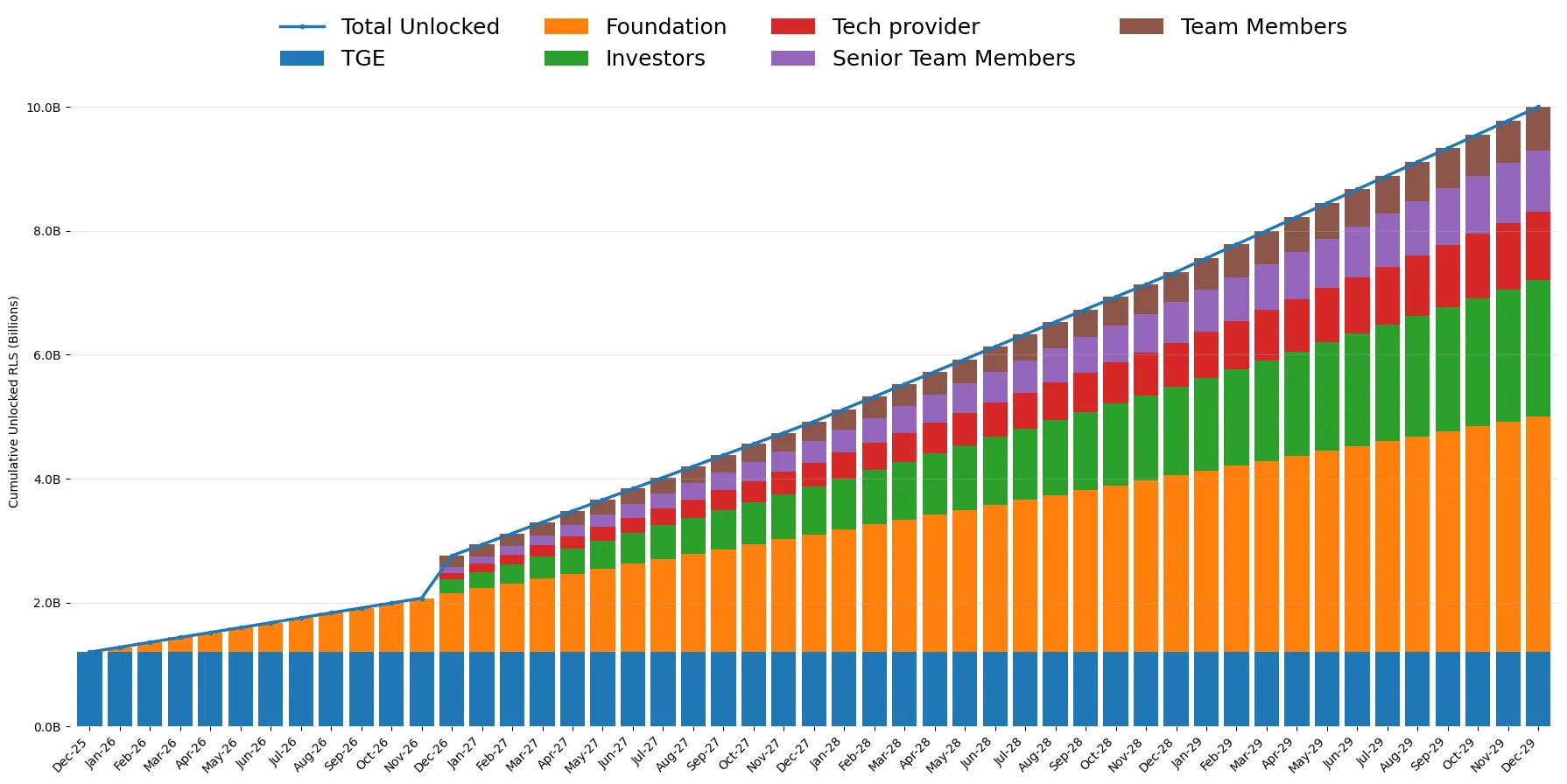
This long-term lockup minimizes sell pressure and demonstrates strong alignment. All non-foundation tokens feature a 12-month cliff followed by 36 months unlock:
· Foundation: no cliff, 48 months linear unlocking
· Investors and senior contributors: 10% at cliff followed by 36 months semi-linear unlocking
· Non-senior contributors: 25% at cliff followed by 36 months semi-linear unlocking
The design ensures that those building and backing the project are incentivized for multi-year success rather than short-term gains.
Foundation unlocks: Controlled and purpose-driven
Rayls generates revenue today from the institutional private chains. You can check the current revenue in the Rayls transparency portal. However, especially in the early days this revenue may not be enough to cover all the foundation’s operational expenses. As such, small amount of tokens may be sold (either in the market or OTC) by the foundation to make up the difference. We expect that over time, this need will be reduced to near zero.
That being said, please note that currently, the only tokens unlocking on a regular basis belong to the Rayls Foundation Treasury and Community allocation (35% of total supply, or 3.5 billion RLS). Even here, the schedule is conservative: 1/48th per month from the locked treasury portion, equating to roughly 73 million RLS per month.
As explained above, these unlocks mostly get saved in the treasury account of the foundation, but some of it may be sold to make up the difference in essential operations that directly support ecosystem growth:
· Salaries for the core team and contributors
· Marketing and partnership development
· Infrastructure services (e.g., company systems, developer tools)
· Community grants, liquidity programs, and security initiatives
In short, foundation releases are not distributed freely: they are operational capital invested back into fostering adoption, building institutional bridges, and increasing the long-term value of the Rayls network (read more about how the foundation uses its funds).
Announcing a new deflationary boost: 10% monthly burn of unlocked foundation supply
Starting in April 2026, the foundation is implementing an additional proactive measure: burning 10% of the monthly unlocked foundation supply.
This decision reflects our commitment to accelerating token scarcity even before fee volumes reach peak levels. By permanently removing a portion of newly unlocked tokens each month, Rayls reduces potential circulating supply incrementally while signaling confidence in the network’s growth trajectory.
Combined with the ongoing 50% fee-burn mechanism from transaction activity, this creates layered deflationary pressure: usage-driven burns (scalable with adoption)
Over time, as private-to-public chain flows increase and institutional volume ramps up, these mechanisms are designed to make $RLS progressively scarcer.
The launch of the Rayls Public Chain mainnet represents more than a technical upgrade, it activates a complete economic model built for real utility.
$RLS serves as staking collateral for validators, a governance token (with future DAO transitions), and the connective asset linking permissioned institutional chains with open DeFi opportunities.
With heavy vesting, transparent onchain fee handling, automatic burns, and validator support via the security pool, Rayls tokenomics prioritize sustainability over hype.
Subscribe to our newsletter